Guide home › Chapter 1
Chapter 1
Manual or automatic? An honest guide for Worcester learners
This is the first decision you make, and it shapes everything after it: how you learn, what your licence lets you drive, and sometimes how long it takes to pass.
I've taught both manual and automatic in more than 20 years as an instructor, and for the last eight or so I've taught in an automatic only. So I know what it's like to learn in each, and where something is my opinion rather than a fact, I say so.
The short version
- Pass in a manual and you can drive both manual and automatic cars.
- Pass in an automatic and you can drive automatic cars only, until you pass a manual test as well.
- An automatic has no clutch and no gears to change, so more of your attention goes on the road, the mirrors and the other traffic.
- Neither is the "proper" way to learn. For most people it comes down to what you feel you can cope with, and you'll usually end up driving whatever you learned in.
- Something to be aware of: an automatic licence doesn't cover manual cars. If you ever needed to borrow a family car, or were given a company car, that's a manual, you wouldn't be able to drive it.
What each licence lets you drive
If you pass your test in a manual car, your licence covers manual and automatic cars. If you pass in an automatic, it covers automatic cars only.
Fully electric cars and most hybrids count as automatics, because you don't change gear in them. (A few "mild hybrids" do have a manual gearbox, so check before you buy.)
Most new cars are now automatic. Only about one in four new models can still be bought with a manual gearbox, and with new petrol and diesel cars ending in 2030, manuals will only get rarer. Plenty of used manual cars will be around for years yet, though.
If you pass in an automatic and later want to drive a manual, you don't start again. You can learn in a manual car on your existing licence (with L plates and a qualified supervisor, as for any learner), and you only have to pass a driving test in a manual car. You don't need to take the theory test again. If you don't pass the manual test, you can still drive automatics.
In my experience, someone who can already drive an automatic usually needs only a handful of manual lessons to get used to the clutch and gears. It isn't like learning all over again. Some people do it on purpose: they pass in an automatic first, then add manual later. That means a second test, a second test fee and some extra lessons, but it lets you get your licence without the clutch to worry about.
The real difference behind the wheel
In a manual car you control the clutch and choose the gear yourself. That's a skill of its own: moving off smoothly, not stalling, holding the car on a hill, and picking the right gear for a bend or a roundabout. Lots of people learn it without much trouble. For others, it's the thing that holds them back.
In an automatic, the car does all of that for you. You still have to learn everything else that makes a safe driver: planning ahead, observation, lane discipline, judging gaps, and dealing with other drivers. Those are the same in both cars, and they're what the test is really about.
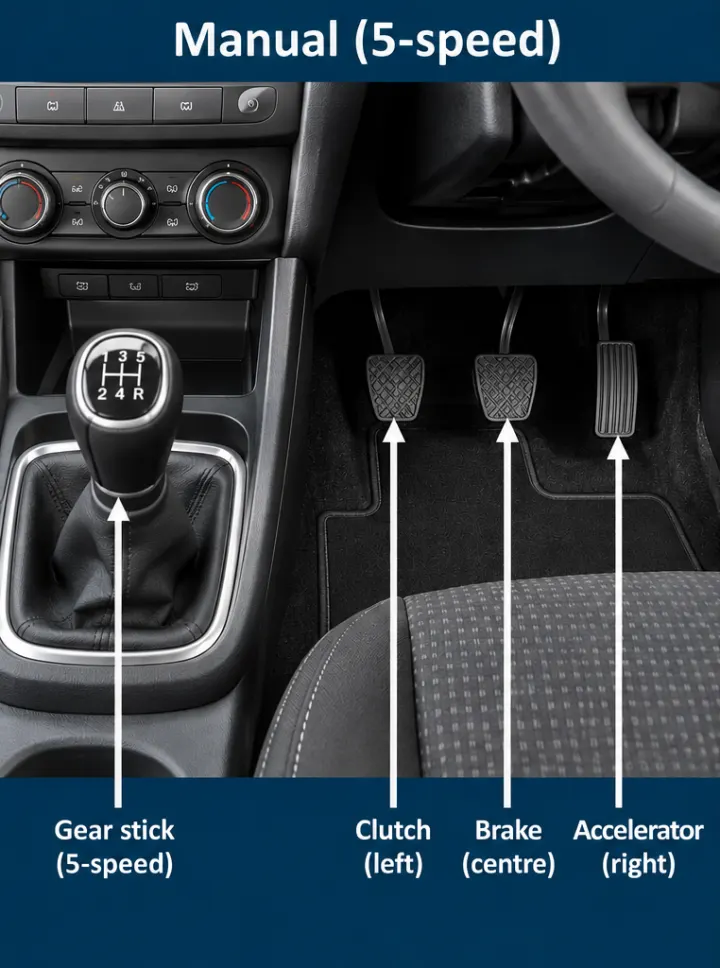
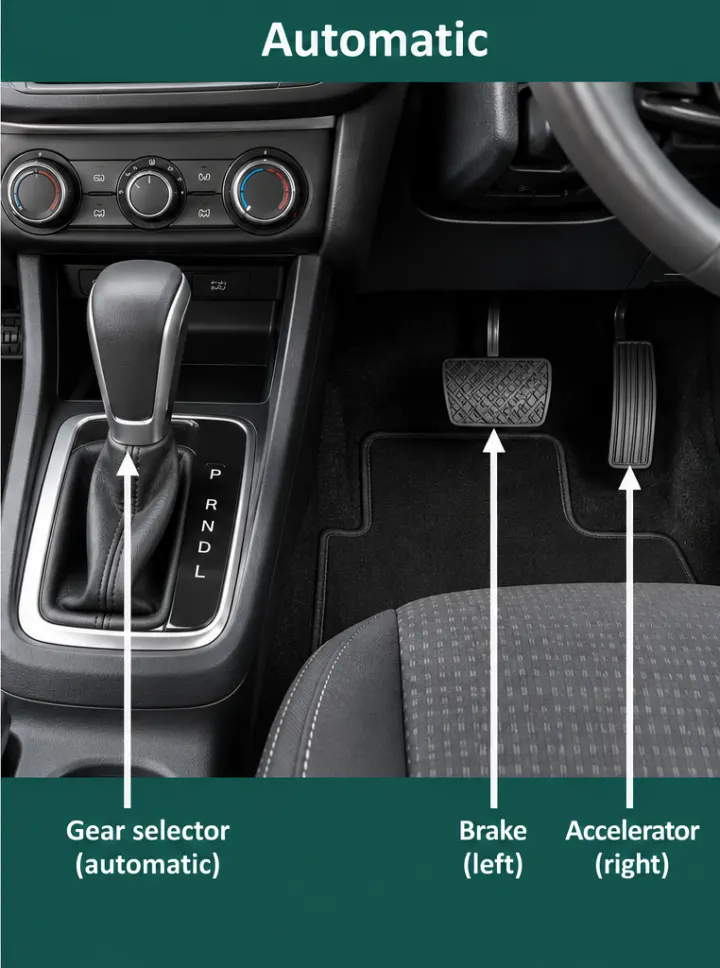
On Worcester's roads you'll notice the difference most in stop-start traffic and on busy multi-lane roundabouts like Six Ways. In a manual, you're judging a gap, choosing a lane and working the clutch at the same moment. In an automatic, you're only judging the gap and the lane.
Who each one tends to suit
Manual can make sense if…
- you'll need to drive a family car that's a manual
- you want the widest choice of cars to buy, hire or borrow
- you'll need to drive a manual company car or van for work
- you're happy to spend some of your lessons on clutch control
Automatic can make sense if…
- you're nervous, or you've found the clutch hard before
- you'll be driving an automatic, hybrid or electric car anyway
- you want to put all your lesson time into the road skills
- you want to get to test standard as quickly as you can
- you're learning later in life, or after a long break
Does automatic mean fewer lessons?
Often, but not always, and nobody can promise you a number. In my experience most learners are ready for their test sooner in an automatic, because with no clutch or gears to think about, they simply have less to worry about. Everyone learns at their own pace, though, so the honest answer is that your instructor should give you a realistic estimate after your first lesson or two.
Lesson prices vary between instructors and between manual and automatic, so it's worth comparing the total you're likely to spend, not just the hourly price.
Practising with family
A provisional licence lets you practise in either kind of car with a qualified supervising driver. Practice is most useful in the same kind of car you have lessons in, so if you're learning in an automatic and the family car is a manual, it's worth thinking about that early.
Five questions to help you decide
- What car will I actually drive in my first year after passing?
- Have I tried a manual before, and how did the clutch feel?
- Will I need to drive a manual for work, or borrow one?
- Would fewer things to think about help my confidence?
- If I pick automatic now, am I happy to take a manual test later if I need to?
Licence facts checked against GOV.UK, Upgrade an automatic car driving licence to a manual one. New-car gearbox figures from CarGurus, March 2026 (67 of 292 new models offered with a manual).